
How to choose the perfect pump
Chosing the perfect pump
Finding the right pump for a water feature can be a challenge, and the stakes are high. The right pump, delivering the right flow at the right head height, while at its best efficiency range, will last and last. Specifying the wrong pump or plumbing can damage the pump, increase operating costs, shorten pump life and lead to pump failure, perhaps even a fish kill if the water feature happens to be a fish pond.
In order to properly size the pump for any water feature, you’ll need to know both components of the work it has to do, the flow and the pressure. The flow is the volume of water it can push in a given time, measured in gallons per hour (GPH). The pressure is the force required to push that flow through plumbing and up to the top of the water feature. We measure pressure in ‘feet of Head”, because it’s easy to visualize. A waterfall four feet high requires the flow be delivered at 4 feet of “Vertical Head”, plus the extra work required to push that flow through the plumbing, the “Friction Head”. The total pressure required is the “Total Dynamic Head” (TDH) of your water feature. Once you know the GPH and the TDH, you can plug them into the Comprehensive Pump Chart (Chart C) to find the right pump.
Follow the steps below to calculate TDH and find the perfect pump for your water feature.
1. Pick the look you want to achieve & the associated GPH/ft




2. Recommended flow calculation
GPH/ft (step 1) | X | Width of waterfall (ft) | = | Recommended flow (GPH) |
|---|
3. Determine friction loss from tubing
Locate the recommended flow GPH (from step 2) and the diameter of the tubing you will be using in your project to find the corresponding friction loss.
Friction loss is listed here for every foot of tubing length used in your project.
Example: For a recommended flow of 3,000 with 2" tubing, the chart shows friction loss of 0.05. In this example project, we will be using 20' of tubing, so the loss here would be 1.
Recommended Flow GPH | Tubing size | ||||||
|---|---|---|---|---|---|---|---|
0.5" | 0.75" | 1" | 1.25" | 1.5" | 2" | 3" | |
100 | 0.10 | 0.01 | |||||
200 | 0.38 | 0.05 | 0.01 | ||||
300 | 0.83 | 0.10 | 0.02 | ||||
400 | 1.00 | 0.18 | 0.04 | 0.01 | |||
500 | 2.23 | 0.27 | 0.06 | 0.02 | |||
750 | 0.50 | 0.14 | 0.04 | 0.02 | |||
1,000 | 0.84 | 0.21 | 0.07 | 0.03 | |||
1,250 | 1.20 | 0.33 | 0.10 | 0.04 | 0.01 | ||
1,500 | 0.43 | 0.15 | 0.06 | 0.02 | |||
2,000 | 0.94 | 0.26 | 0.10 | 0.03 | |||
3,000 | 2.07 | 0.52 | 0.22 | 0.05 | |||
4,000 | 1.10 | 0.43 | 0.09 | 0.01 | |||
5,000 | 1.80 | 0.67 | 0.15 | 0.02 | |||
6,000 | 0.96 | 0.22 | 0.03 | ||||
8,000 | 1.77 | 0.38 | 0.05 | ||||
10,000 | 0.59 | 0.07 | |||||
12,000 | 0.84 | 0.10 | |||||
15,000 | 0.15 | ||||||
18,000 | 0.25 | ||||||
4. Determine fitting length in feet
Located the fitting types that will be used and the fitting size. The corresponding number is the fiction loss per connection as a calculation to the equivalent if that fitting was a straight piece of tubing. For applications with multiple connections, add all corresponding values.
Example: For this project, we need one standard elbow 90°, one male to female adapter, and one swing check valve. All are 2" in diameter, so 8.5 + 4.5 + 19.0 = 32
PVC Fitting Type | Fitting size | |||||
|---|---|---|---|---|---|---|
0.5" | 1" | 1.25" | 1.5" | 2" | 3" | |
Standard Elbow 90° | 4.5 | 5.5 | 7.0 | 7.5 | 8.5 | 11.0 |
Standard Elbow 45° | 1.0 | 1.5 | 2.0 | 2.5 | 3.0 | 4.0 |
Male to Female Adapter | 1.5 | 2.0 | 3.0 | 3.5 | 4.5 | 6.5 |
Tee (used straight through) | 2.5 | 3.0 | 5.0 | 6.0 | 8.0 | 12.0 |
Tee (used through a branch) | 5.5 | 7.0 | 9.0 | 10.0 | 12.0 | 17.0 |
Swing Check Valve | 9.0 | 11.0 | 13.0 | 15.0 | 19.0 | 27.0 |
Calculate total equivalent tubing length
Fitting length (ft) (from chart above) | + | Length of tubing (ft) | = | Total equivalent tubing length (ft) |
|---|
5. Calculate friction head
Combine totals from step 3 and 4.
Friction loss | x | Total equivalent tubing length (ft) | = | Friction head (ft) |
|---|
6. Find the total dynamic head
Vertical head is the height in feet from the surface of the water the pump will be sitting in, to the highest point the water is pumped to.
Friction head (ft) | + | Vertical head (ft) | = | Total dynamic head |
|---|
7. Choose you pump
Find the total dynamic head at the top of this chart, then find the pumps below that provide at least that recommended flow. Grey colored cells indicate that the total dynamic head is outside the pump’s operating range and the pump will likely not last in this application. The light blue cells indicate the pump is operating within its operating range. Dark blue means the total dynamic head is in the pump’s best efficiency range, where the pump will run best and longest. If the chart gives you a choice of more than one pump, check for the type that best fits your application, then check for the lowest wattage, to save on operating costs.

Pro tips: what you need to know about pumps & plumbing
Pro tip: Flow, pressure, & the best efficiency point
All pumps have an optimal range of flow, measured in GPH, and pressure, measured in feet of Head. Pumps operating within their Recommended Operating Range will run better and last longer. Pumps forced to run outside their operating range will tend to fail sooner. Every waterfall needs a certain amount of flow at a certain amount of pressure to achieve a desired effect. Knowing the feature’s Recommended Flow in GPH, and its Total Dynamic Head in feet, lets you select the right pump, running in its optimal range, providing the desired flow at the right head.
Pro tip: Area vs. circumference
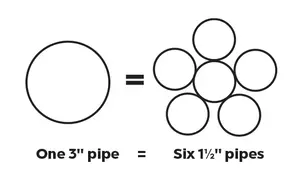
Though it might seem that two 1.5" pipes would deliver the same amount of water as one 3" pipe, appearances are deceiving. Flow is a function of area; calculating their areas proves FOUR 1.5" pipes equal one 3" pipe.
But friction is a function of circumference. Four 1.5" pipes have TWICE the surface area of the 3" pipe, and consequently, twice the friction loss. To deliver equal flow, the pipes must have equivalent friction losses.
At 8000 GPH, friction loss through 3" pipe is .05 feet of head per foot of tubing. Through four 1.5" pipes at 2000 GPH each, friction doubles to .10. It takes SIX 1.5" pipes at 1333GPH to lower the friction coefficient to .05 and deliver the same amount of water as the 3" pipe.
Though 3" flex PVC is expensive, it costs less than six lengths of 1.5" pipe and takes less time to install. Whenever possible, larger diameter pipe pays off.
Area of pipe:
11/2" = 1.77 in2 (0.752π)
3" = 7.07 in2 (1.52π)
Circumference of pipe:
1.5" Pipe = 4.71"
3" Pipe = 9.42"
Friction loss:
8000 gph through 3" = 0.05 ft of head loss per foot of tubing
1333 gph through 1.5" = 0.05 ft of head loss per foot of tubing
Pro tip: Decreasing TDH for low head pumps
Total Dynamic Head is the combination of Friction Head, the restriction caused by the plumbing, and the Vertical Head, the height the water is pumped to. The lower the TDH, the higher the flow will be. The height of the feature is fixed, but eliminating friction is an easy way to increase flow without buying a bigger pump. Restrictive plumbing adds friction head, robs flow and tends to shorten pump life. Low head pumps should typically be plumbed with generous tubing to reduce friction and increase both flow and pump life. The Friction Loss Chart provides the optimal size tubing to eliminate excess Friction Head.
LOWER THE TDH = MORE FLOW
LARGER PLUMBING = LESS TDH
Pro tip: Increasing TDH for high head pumps
Lowering TDH is not always desired. Unlike low head pumps, high head pumps usually require a minimum amount of head to function. Too little TDH will lead to overspeeding, overheating and cavitation, which can destroy both motor and impeller. If the pump you want to use will be happier at a higher TDH, install a ball valve on the discharge line to restrict the flow and raise the head pressure into the recommended operating range. (Note that Head is the same as pressure; every one foot of Head equals .433 psi, but Head Height is a lot easier to visualize than pounds per square inch!)
Pro tip: Cost to run a pump
Take what you pay per kilowatt per hour, multiply that by the wattage of the pump and divide by 1000. For the monthly cost, multiply the hourly cost by 720, 24 hours per day times 30 days in a month.
Cost per hour = $ kW x Watts ÷ 1000 = x 720 = Cost per month
Example: Electric costs $0.10 per kW, the pump draws 100 Watts, so $0.10 kW x 100W ÷ 1000 = $0.01/hr x 720hrs/mo = $7.20/month
Download
How to choose the perfect pump guide
- Download
How to choose the perfect pump
Download guide